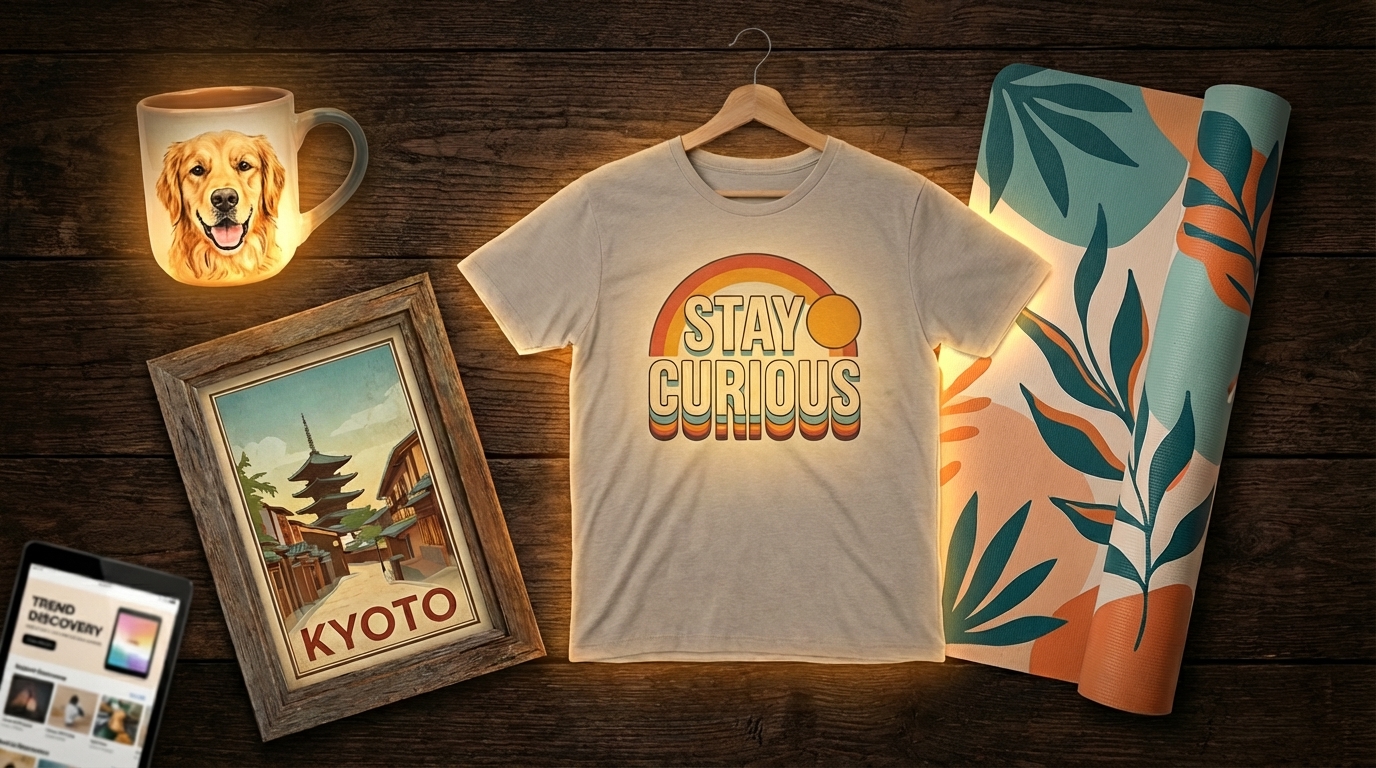
Disclosure: This post contains an affiliate link to Gelato. If you sign up through our link, we may earn a small commission at no extra cost to you.
The most profitable print-on-demand niches in 2026 reward specificity over breadth. Home decor and wall art lead with a 28% CAGR. Pet products, micro-aesthetics, and occupation humor remain strong. The winning formula: combine an identity + an interest + a design style, then test with batch mockups before you commit.
Most "best POD niches" lists recycle the same five ideas every year. Custom mugs. Funny t-shirts. Yoga stuff. And then sellers jump in, discover there are 400,000 competitors, and quit.
This guide is different. We researched actual search trends, Etsy demand data, and market projections for 2026 to tell you which niches still have room, which ones are oversaturated, and exactly how to position yourself within each one. We also tell you which niches to avoid unless you have a genuine edge.
Let's get into it.
1. Home Decor and Wall Art
Home decor is the single fastest-growing POD category right now, and it is not close. Canvas prints, metal prints, framed posters, throw blankets, and decorative pillows are driving massive demand. People are willing to spend more on wall art and home accessories than on another graphic tee, which means higher price points and better margins.
The opportunity here is in specificity. "Abstract wall art" is crowded. "Minimalist desert landscape canvas for mid-century modern living rooms" is not. Think about the room, the style, and the buyer persona when you design.
Start with poster templates and framed mockups. Test 10-15 designs in a specific aesthetic before expanding. Use poster frame mockups to create professional listings without photographing a single product.
Sub-niches worth exploring:
- Botanical and plant illustrations for boho interiors
- Typography prints with meaningful quotes (not generic motivational slogans)
- City and architecture line art for apartment dwellers
- Nursery wall art sets (parents buy in bundles of 3-4)
- Personalized family name signs and coordinates prints
Saturation warning: Generic motivational quotes and basic abstract shapes are extremely crowded. You need a recognizable style or a narrow audience to stand out.
2. Pet Products
Pet owners are, statistically speaking, a little unhinged about their animals. And that is great news for POD sellers. Custom pet portraits continue to be one of the highest-converting POD products on Etsy and Shopify. But the category has expanded well beyond portraits into blankets, mugs, phone cases, throw pillows, and apparel.
The AI portrait angle has driven prices down in some segments, but it has also expanded the total market dramatically. More people now know they can get their dog painted in a Renaissance style. That awareness benefits everyone in the space.
Multi-pet compositions (two or three pets together) command premium pricing. Breed-specific humor apparel ("Golden Retriever Mom" is a personality type at this point) converts well. Pet memorial products are a sensitive but high-demand sub-niche with very loyal customers.
Sub-niches worth exploring:
- Breed-specific home decor and apparel
- Pet and owner matching designs
- Cat-specific products (often underserved compared to dogs)
- Exotic pet communities: reptiles, birds, rabbits
- Pet memorial and tribute products
Saturation warning: Generic "dog mom" products are oversaturated. Breed-specific and multi-pet products still have room.
3. Personalized Apparel
The personalized apparel market has shifted. Five years ago, it was mostly custom text on a t-shirt. In 2026, it is about identity expression. Buyers want apparel that signals who they are, what they believe, and which communities they belong to.
This is where the "niche equation" matters most. "Yoga shirt" is a commodity. "Yoga shirt for night-shift nurses who do hot yoga" is a product with a built-in audience that will share it with friends who are exactly like them.
Use t-shirt mockups and t-shirt templates to create listing images fast. Test designs in small batches of 5-10. Kill what does not sell in 30 days. Double down on what converts.
Sub-niches worth exploring:
- Hobby-specific identity apparel (birdwatching, rock climbing, gardening)
- Profession + humor crossovers
- Cultural and heritage pride designs
- Matching family or group apparel for events
- Subtle, design-forward pieces that do not scream "print on demand"
Saturation warning: This is the most crowded POD category overall. Success requires either exceptional design quality or extremely narrow targeting. Ideally both.
4. Fitness and Wellness
Health and wellness is not a trend. It is a permanent lifestyle shift, and it keeps growing. Custom yoga mats, gym towels, motivational water bottles, and workout apparel are all viable POD products in 2026.
The key insight here is that fitness buyers are tribal. CrossFit people buy CrossFit things. Pilates people buy Pilates things. Marathon runners buy marathon things. These tribes do not overlap much, which means you can own a small segment without competing against the entire fitness market.
Combine fitness with another identity. "Yoga + plant mom." "Weightlifting + dad jokes." "Running + introvert." These crossover identities create products that feel personal rather than generic.
Sub-niches worth exploring:
- Home gym decor (posters, motivational prints)
- Discipline-specific gear (pilates, climbing, martial arts)
- Recovery and mental health wellness products
- Fitness milestone celebration items (first 5K, first pull-up)
Saturation warning: Generic "no pain no gain" designs are dead. Tribe-specific and crossover designs still have room.
5. Sports and Fan Communities
Sports fans spend money. They spend it repeatedly. And they spend it emotionally, which is the best kind of spending for a POD seller. Local leagues, club sports, fantasy sports, and niche athletic communities all create demand for custom apparel and accessories.
You cannot use official team logos or player likenesses. But you absolutely can create designs around the culture, the inside jokes, and the shared experiences of fan communities. "Game day" culture, tailgating humor, and sports-parent life are all fair game.
Sub-niches worth exploring:
- Youth and club sports team gear for parents
- Fantasy sports league apparel and mugs
- Pickleball (still surging in participation)
- Women's sports fan merchandise
- Retired athlete humor ("I peaked in high school" type designs)
Saturation warning: Anything that skirts trademark territory is a fast way to get your shop shut down. Stay in the culture lane, not the logo lane.
6. Micro-Aesthetics and Niche Crossovers
This is the biggest shift in POD strategy for 2026, and most sellers are still missing it. Stop thinking in single-word niches. Start thinking in equations.
The formula: Identity + Interest + Aesthetic = Micro-Niche
Here is what this looks like in practice:
- Cottagecore + Dog Training: Soft, pastoral illustrations featuring dog training scenarios
- Retro Sci-Fi + Book Lovers: 1950s pulp fiction-style designs about reading
- Dark Academia + Nursing: Moody, literary-themed nurse humor
- Minimalist + Fishing: Clean, modern takes on fishing culture
- Kawaii + Weightlifting: Cute cartoon characters doing deadlifts
These combinations feel fresh because they are. No one has saturated "kawaii weightlifting" because no one has thought to combine them at scale. Each intersection gives you a small, passionate audience that is underserved.
Pick your crossover, design 10 products, and create all your product mockups in one batch. Test on Etsy for 30 days. If it works, expand the line. If it does not, try a different equation. Batch mockup tools like Scaylr make this test-and-iterate cycle fast.
Saturation warning: None. That is the entire point. You are creating the niche, not entering one.
7. Eco-Friendly and Sustainable Products
Sustainability is no longer a differentiator. It is a baseline expectation for a growing segment of buyers, especially younger ones. POD sellers who lean into eco-friendly messaging, organic materials, and conscious design are capturing a premium market that is willing to pay more.
This niche works best when it is authentic. Slapping "eco" on a standard product does not work. Partnering with a POD provider like Gelato (referral link) that offers organic and sustainable product options, and then designing around that story, does work.
Sub-niches worth exploring:
- Nature conservation and wildlife awareness designs
- Garden and plant-themed products on organic materials
- Ocean and marine life conservation
- Minimalist, earth-tone aesthetic products
- "Buy less, choose well" anti-consumerism messaging (yes, the irony sells)
Saturation warning: Greenwashing will backfire. If your products are not actually produced sustainably, do not claim they are. Buyers in this niche do their homework.
8. Occupation and Profession Humor
Nurse humor. Teacher gifts. Programmer jokes. Accountant life. This niche has been around for years and it is still printing money because it taps into one of the strongest POD purchase motivations: gifting.
People buy these products for coworkers, friends, and family members. That means your buyer is often not the end user, which changes how you should design and market. Gift buyers want something that is immediately recognizable, clever, and safe to give in a professional setting.
Nurse appreciation week, teacher appreciation week, administrative professionals day, and holidays like Christmas drive massive spikes. Plan your designs and listings 6-8 weeks before these dates. Use optimized listing images to maximize conversion during peak periods.
Sub-niches worth exploring:
- Healthcare professions beyond nursing (radiology, pharmacy, PT)
- Trades and blue-collar professions (electrician, plumber, welder)
- Remote work and WFH humor
- Retirement gifts by profession
- New grad gifts by field of study
Saturation warning: "Best nurse ever" and "world's okayest teacher" have been done to death. The opportunity is in insider humor that only people in the profession understand. If you have to explain the joke, it is the right joke for this niche.
How to Validate a Niche Before You Commit
Picking a niche is step one. Validating it before you invest serious time is what separates profitable sellers from hobbyists. Here is a practical process:
Search Etsy for demand signals
Look at the number of results for your niche keywords. High result counts mean demand exists but competition is real. Low result counts with active shops and reviews mean you found a gap. Zero results might mean there is no demand at all.
Check the top sellers
Look at the first page of results. If the top listings have thousands of sales, there is proven demand. If even the top sellers have few sales, the niche might be too small. Look at their listing photos for quality benchmarks.
Create test designs and mockups
Design 5-10 products and generate mockups for all of them in one session. Professional mockups are non-negotiable for testing because poor listing images will kill conversion regardless of how good the design is. Check the mockup guide for best practices.
Launch and measure for 30 days
List your products with optimized titles and tags. Track views, favorites, and sales. After 30 days, you will know if this niche is worth expanding or if you should try a different angle.
Ready to test your niche?
Generate professional mockups for posters, t-shirts, and mugs in minutes. Start with 30 free mockups per day.
Create Mockups FreeThe Niche Equation: Your 2026 Strategy
The single biggest mistake POD sellers make in 2026 is thinking too broadly. "I sell t-shirts" is not a business. "I sell cottagecore-aesthetic apparel for women who garden and own chickens" is a business with a built-in audience, clear design direction, and search terms buyers actually use.
Here is how to build your niche equation:
- Pick an identity: Who is your buyer? (nurse, dog owner, gardener, dad, introvert)
- Add an interest: What do they care about? (yoga, reading, fishing, coffee)
- Choose an aesthetic: What visual style appeals to them? (minimalist, retro, kawaii, dark academia)
- Select your products: What do they actually buy? (posters, t-shirts, mugs, blankets)
The intersection of those four elements is your niche. The more specific the intersection, the less competition you face and the more your products feel like they were made for that exact person.
Generic motivational quotes, basic "mama bear" designs, plain text on solid backgrounds, and anything that relies on trending pop culture references you do not have a license for. These are either oversaturated, legally risky, or both.