Updated 8 October 2026. Etsy's rules re-checked in its Seller Policy, and email platform limits on their pricing pages; sources at the end. Unsourced numbers from the earlier version were removed.
To build an email list as an Etsy seller, invite buyers to sign up on your own page (for a free download or a discount) and mention it in your shop announcement, About section and package inserts: Etsy's Seller Policy says you may not add any Etsy member to your mailing list without their consent. Free email plans are enough to start: Mailchimp's free plan covers 250 contacts, Kit's up to 10,000 subscribers.
| Question | Answer |
|---|---|
| Can you email Etsy buyers your newsletter? | Only with their consent. Order details may only be used for Etsy-related communication. |
| Can you advertise in Etsy messages? | No unsolicited advertising or promotions in messages |
| Mailchimp free plan | 250 contacts, 500 emails a month, no automations |
| Kit free plan | Up to 10,000 subscribers, unlimited landing pages and forms |
| Carrd with custom domain and forms | Pro Standard, $19 a year |
Most Etsy sellers do not think about email until something goes wrong. A shop gets suspended. A search change cuts traffic. A niche gets flooded with competitors and their ranking disappears. At that point, the sellers who have built an email list have options. The ones who relied entirely on Etsy do not.
Building a list while things are going well is the only time it is easy. Here is how to actually do it.
Can Etsy sellers collect buyers' email addresses?
Not for marketing without consent. Etsy's Seller Policy says you may receive a buyer's email address as part of a transaction, but that information may only be used for Etsy-related communications or Etsy-facilitated transactions, not for unsolicited commercial messages. Without the buyer's consent, you may not add any Etsy member to your email or physical mailing list. The same policy bans unsolicited advertising or promotions in the content you send on Etsy, including messages.
What you can do: point people to a page outside Etsy where they can voluntarily sign up for something they want. The distinction is consent. A buyer who signs up on a landing page because they want a free download has opted in. A buyer whose email you copied from an order has not.
If you sell to buyers in the EU, Etsy also reminds sellers that storing a buyer's information outside Etsy (for example an email address for a newsletter) means following data protection rules: be transparent about how you use it, and stop if they ask (Etsy Help: GDPR).
This means list-building for Etsy sellers happens almost entirely outside Etsy, through channels you own or control. Etsy is the starting point for the customer relationship, but the list itself lives elsewhere.
What is a good lead magnet for an Etsy shop?
A lead magnet is something a buyer wants enough to exchange their email address for it. For Etsy sellers, the most practical options are a free digital download, a discount code, or exclusive content related to what you sell.
A free printable works particularly well if you already sell digital products. A buyer who found your botanical print shop can be offered a free botanical colouring page, a free phone wallpaper in your signature style, or a free mini-print sized for an Instagram frame. The offer is directly related to what they already bought, which means the people who sign up are exactly the buyers most likely to purchase from you again.
A discount code for their next order ("join my list for 15% off") suits shops selling physical POD products. You give up some margin on one order in exchange for a direct line to a buyer who has already shown interest. Keep the offer pointing back to your Etsy shop: Etsy's Seller Policy doesn't allow content that encourages off-platform transactions.
Style guides or how-to content work for sellers whose products require some buyer knowledge to use well. A Canva template seller offering a free "how to customise your template" guide attracts exactly the buyers who purchased the template and might buy more.
It has to be genuinely useful or desirable, not just technically free. A low-quality freebie attracts sign-ups who immediately unsubscribe. A lead magnet that delivers real value, something a buyer would have paid for, attracts subscribers who trust you enough to open your emails later.
Where should Etsy sellers collect sign-ups?
You need a sign-up page outside Etsy. Simple options are a free landing page from your email platform (Kit's free plan includes unlimited landing pages and forms), a Carrd site (Pro Standard at $19 a year adds custom domains and sign-up forms), or a page on Squarespace or WordPress if you already have a site.
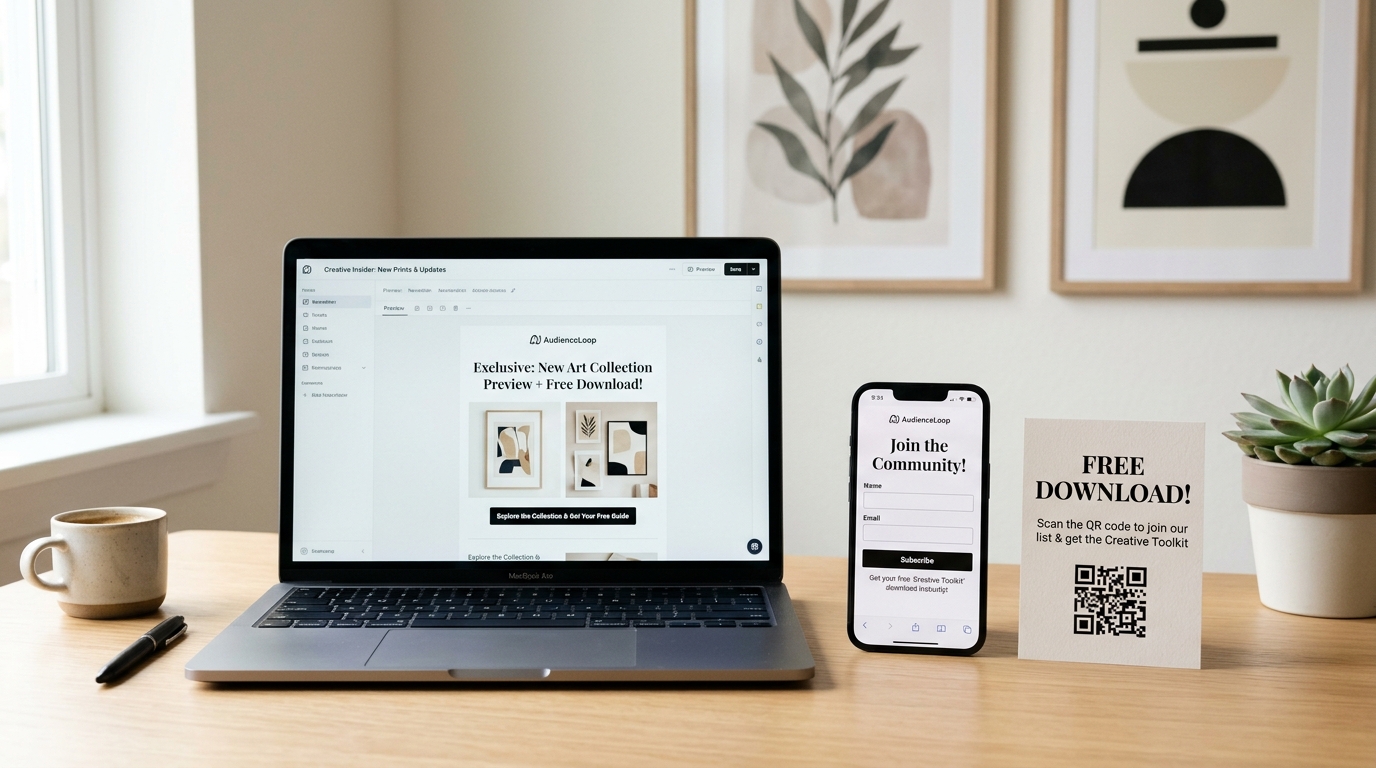
The page does not need to be elaborate. A headline explaining what they get, a brief description, one image, and an email sign-up field. That is the whole page. The quality of the lead magnet matters far more than the design of the page.
Once the page exists, tell people about it. On Etsy, your shop announcement and About section are spaces you control where you can mention the free download. Keep order messages about the order itself, since Etsy's Seller Policy bans unsolicited advertising in messages.
Package inserts work well for sellers whose POD products ship physically. A small card in the package with a QR code linking to the sign-up page catches buyers at the moment they are most engaged: just received the product, probably happy with it, might be thinking about what to order next.
Which social channels help grow an email list?
Pinterest and Instagram are natural channels for most Etsy sellers because the content format (images of products and designs) maps to what you are already producing. Both can send people to your sign-up page.
On Pinterest, a pin linked to your sign-up page, or to a blog post with a sign-up form, can keep bringing visitors long after you post it, which an Instagram post rarely does. A well-made pin showing your free download and linking to the sign-up page is worth making for every lead magnet.
On Instagram, use the link in your bio or a link sticker in Stories. The key is consistency: mention the free download regularly rather than pinning your hopes on a single post.
Which email platform should an Etsy seller use?
Mailchimp's free plan covers up to 250 contacts and 500 emails a month (250 a day), and doesn't include automations. It's fine for a first small list; sending pauses if you go over the limits.
Kit (formerly ConvertKit) has a free plan for up to 10,000 subscribers with unlimited landing pages and forms, which makes it the more generous free starting point. It is built for creators who plan to grow a list through content: a blog, a YouTube channel, a regular newsletter. Its visual automations, such as a welcome sequence, are on its paid plans.
Klaviyo is built for shops with enough sales that purchase-based segmentation (sending different emails to buyers who purchased X versus Y) is worth the setup. For most small Etsy shops it's more than they need at the start.
Start on a free plan. Move when you outgrow it, not before.
What should you send to your list?
The most common failure for seller email lists is not a lack of subscribers. It is collecting sign-ups, doing nothing with the list for six months, and then sending an email that starts "Sorry I haven't been in touch..." to subscribers who have forgotten who you are.
A minimal but consistent approach is more valuable than an elaborate one that never happens. One email a month is enough to keep a small list warm. The content does not need to be complex: new products added to the shop, seasonal designs coming up, a behind-the-scenes look at something you made recently, or a curated selection of items for an upcoming occasion.
If your plan includes automations, a welcome sequence (two or three automated emails over a new subscriber's first week) does more work per subscriber than any broadcast. Email one delivers the lead magnet. Email two introduces the shop and your best-selling products. Email three offers a small discount or early access. New subscribers are paying the most attention right after they sign up, which is why the welcome emails matter. On a plan without automations, send the download right away by hand or from the sign-up confirmation.
When does an email list start to pay off?
Sooner than most sellers expect. A list of a few hundred engaged subscribers is more valuable than it sounds, because every email reaches people who already know and chose your shop, without paying for ads to reach them.
The value compounds as the list grows and as your relationship with subscribers deepens. Subscribers who have been on your list for months and bought from you once are the buyers most likely to leave reviews, share your shop with friends, and return for seasonal purchases.
For the broader picture of building a shop that is not entirely dependent on Etsy's algorithm, the Etsy brand guide covers the decisions that make a shop recognisable and trustworthy. And for the product side, the product launch guide walks through how to take a new listing from research to live.
An email list is the only customer communication channel an Etsy seller fully controls. It is not urgent to build: a shop can grow to hundreds of sales without one. But the shops that last longest are the ones that eventually own some part of their audience relationship rather than renting it entirely from Etsy. Building the list while things are good is far easier than trying to build it during a crisis.
Sources (checked October 2026): Etsy Seller Policy (buyer information, messages) · Etsy Help: GDPR · Mailchimp pricing · Kit pricing · Carrd Pro.
Make your Etsy listings worth sharing
Better mockups mean more buyers discover your products through Pinterest and word of mouth, the organic channels that feed your list over time.
Try Scaylr Free →