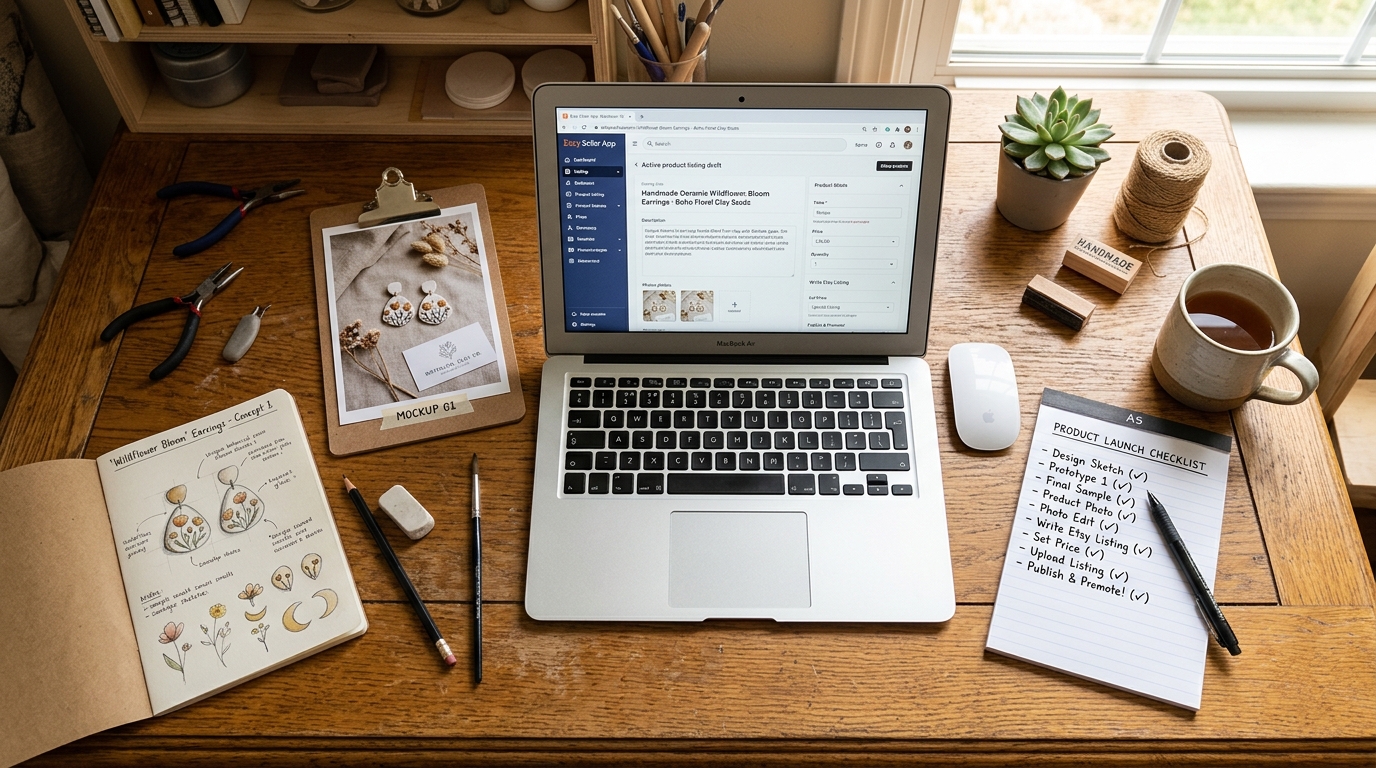
A successful Etsy product launch starts with research, not design. Find out what buyers are already searching for, then build a product around that demand. The listing does most of the selling: title, tags, images, description. The first two weeks matter more than most sellers realise — early clicks and conversions signal to Etsy's algorithm whether a listing is worth showing to more people.
Most new Etsy listings get almost no views. It's not because Etsy is oversaturated. Most listings skip the research that would have told the seller whether anyone was looking for that product in the first place.
A launch that works follows a sequence: research, design, mockups, listing, promotion. Doing them in the wrong order wastes time. This is the order that works.
Step 1: Research before you design anything
Validate demand before committing to a design
The fastest way to find products worth making: search Etsy for the niche you're considering and look at what already sells. Etsy shows "Bestseller" badges on listings with consistent sales. Note what the top-performing listings have in common: price, style, format, the exact words they use in titles.
Etsy's search autocomplete is a direct window into what buyers type. Search your core keyword and read the suggestions. Those are real queries from real buyers. If "boho nursery wall art" autocompletes, that's a confirmed search term worth targeting.
Look for niches where the top listings are clearly selling but the page 2 results are noticeably weaker. Strong demand with a soft middle means there's room for a listing that's properly optimised to rank above average results.
A product with confirmed demand (bestsellers exist), reasonable competition (not 50,000 results), and a gap you can fill: a better design, a specific sub-niche that's underserved, or simply better photos than everything currently ranking.
Step 2: Design for the search, not just for yourself
Build the design around what buyers are looking for
The designs that sell on Etsy are the ones that match what buyers already have in mind when they search. That doesn't mean copying existing products. It means understanding the aesthetic, tone, and use case the buyer expects, then creating something that fits that expectation while being distinctly yours.
If the research shows that "dark academia quote prints" are selling well in muted tones with serif fonts, making something bright and sans-serif in that niche will struggle. Not because it's a bad design. It just doesn't match the buyer's mental image of what they're searching for.
Specificity always outperforms generality. "Wildflower botanical print for bathroom" is a more searchable, more purchasable product than "floral art print." The more precisely your product matches a buyer's intent, the better it converts when they find it.
Step 3: Build your mockup set before writing the listing
Create listing images that do the selling
Your first listing image is the most important element in your entire listing. It's what determines whether a buyer clicks through from search results. Everything else: title, description, price. None of it matters if the image doesn't get the click.
For a standard product launch, build a set of 5 to 7 images:
Image 1 (lead): The strongest lifestyle mockup you have. Product in a real setting, well lit, styled. This is your click driver.
Images 2-3: Different context shots. Alternative room settings, different frame or colour variants, seasonal styling if relevant.
Image 4: Scale reference. Show the product next to something familiar — a hand, a piece of furniture — so buyers can judge actual size.
Image 5: Detail or flat shot. The design itself clearly visible, no distracting background.
Images 6-7 (optional): Close-up details, packaging if relevant, or a graphic showing product specifications.
Batch generating your mockup set before writing the listing means you can write more accurately. You know exactly which variations you're listing and what the images show. Tools like Scaylr run all your designs through multiple templates at once, so the image set for a full launch takes minutes rather than hours. The free template library has wall art and poster templates ready to use.
Step 4: Write a listing that matches how buyers search
Optimise title, tags, and description for search
Etsy's search algorithm uses your title, tags, and the start of your description to determine which searches your listing appears in. Getting this right isn't optional. It's the difference between a listing that gets found and one that doesn't.
Title: Lead with the most specific, searchable phrase. "Boho Nursery Wall Art Print, Wildflower Botanical, Neutral Tones" gets found for multiple related searches. "Beautiful Floral Art Print" gets found for almost nothing useful.
Tags: Etsy gives you 13 tags, each up to 20 characters. Use all 13. Mix broad terms ("wall art," "art print") with specific ones ("boho nursery decor," "wildflower print") and long-tail phrases ("neutral nursery wall art"). The goal is covering the full range of ways a buyer might search for your product.
Description: The first 160 characters are indexed by Etsy and visible in search previews. Lead with the most important information: what the product is, the size, the format. Don't start with your shop story.
For a deeper look at Etsy search optimisation, the Etsy SEO guide covers keyword research, tag strategy, and how the algorithm weighs different listing elements.
Step 5: Price it properly from day one
Set a price you can sustain, not just compete on
The instinct to undercut competitors is almost always wrong. A price noticeably lower than the market average signals low quality to buyers who don't know your shop yet, and leaves you earning less per sale for the same work.
Price relative to what comparable listings charge, then look at what you're actually earning after Etsy's fees (6.5% transaction fee + ~3% payment processing + $0.20 listing fee). If you're selling a print-on-demand product, subtract your production and shipping cost too. What's left needs to be worth the effort of maintaining the listing.
If the market price doesn't leave you with a viable margin, the problem is usually the niche or the product type, not the price. Lowering your price further compounds the problem rather than solving it.
Some sellers launch at a slightly lower price to generate early sales and reviews, then raise the price once the listing has history. This can work, but the gap should be small enough that it doesn't undercut your positioning. Launching at half the market rate to "get traction" tends to attract buyers who wouldn't have paid a fair price anyway, and they leave reviews that don't reflect the product's real value.
Step 6: The first two weeks
Give the algorithm something to work with
Etsy's algorithm is conservative about new listings. It shows them to a small slice of relevant searchers first, then expands or contracts that exposure based on how well the listing converts. A new listing that gets clicks and sales early moves up in results. One that gets shown and ignored fades quickly.
This is why the first two weeks matter more than most sellers plan for. A few things that help:
Etsy Ads on a small budget. Even $1 to $3 per day can accelerate early visibility and give the algorithm data to work with. Run ads for 2 to 3 weeks, then evaluate which listings are converting and cut the ones that aren't.
Share to Pinterest. Pinterest images are indexed by Google, drive long-term referral traffic, and are particularly effective for visual products like wall art and printables. Pin your listing images to relevant boards on launch day.
Share to your existing audience. If you have a social following, email list, or community presence, let them know. First-week sales from your own channels seed the listing with purchase history that Etsy can use as a quality signal.
After two weeks, check your listing stats. If impressions are low, the title and tags likely need work. Search for your product on Etsy as if you were a buyer and see what comes up. Use those exact phrases. If impressions are reasonable but clicks are low, the lead image needs to be stronger. If clicks are good but sales are low, price or listing copy is the issue.
What to do when a listing underperforms
Most new listings need at least one round of optimisation before they find their footing. The stats in your Etsy dashboard tell you where the breakdown is happening.
Low impressions: the listing isn't appearing in relevant searches. Revise the title and tags. Search for your product on Etsy as a buyer and use those exact phrases.
Good impressions, low clicks: the lead image isn't compelling enough. Test a different primary photo: a stronger lifestyle shot, different room setting, or a closer crop that shows the design more clearly.
Good clicks, low conversion: something is creating friction. Price too high, description unclear, not enough images, or the product doesn't match what buyers expected based on the title. Read your listing as a first-time visitor and look for anything that would make you hesitate.
A product launch on Etsy is less of a one-time event and more of an opening bet that you refine based on data. The research and listing quality you put in before launch determine your starting position. What happens after launch determines whether the listing reaches its potential: adjusting based on stats, supporting with ads or Pinterest, iterating on images. Neither phase works without the other.
Get your listing images ready before launch day
Generate a full set of lifestyle mockups for your new product in minutes. Upload your design, pick your templates, download and list.
Try Scaylr Free →