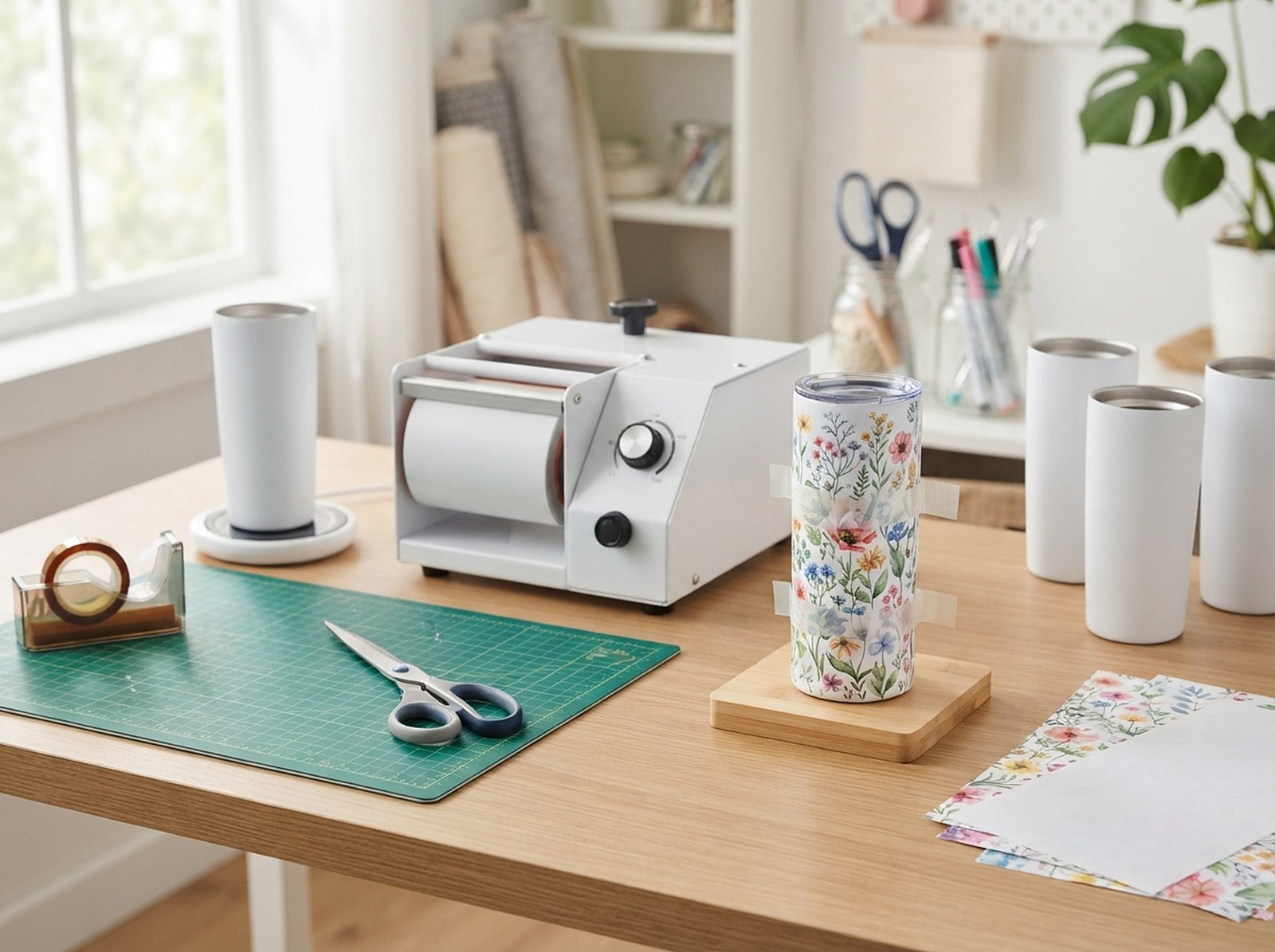
Buy a "20oz tumbler template" and there's a real chance it's the wrong shape for the blank sitting on your desk — because "20oz tumbler" describes two genuinely different shapes, straight and tapered, and a template built for one wrinkles and gaps on the other. This is what the difference actually is, the real size numbers, and how to get a template that fits.
A straight tumbler has the same circumference top and bottom, so its wrap is a plain rectangle. A tapered tumbler is narrower at the bottom than the top, so its wrap unrolls into a curved, non-rectangular panel — using a straight rectangular template on a tapered tumbler causes wrinkles and a gapped seam. At 20oz, a skinny straight wrap runs about 9.1×8.25 in, while a skinny tapered wrap runs about 9.3 in (top) tapering to 8.5 in (bottom) by 8.2 in tall. Always match the template to the exact shape of your blank, not just its volume.
What "straight" and "tapered" actually mean
The names describe the tumbler's side profile:
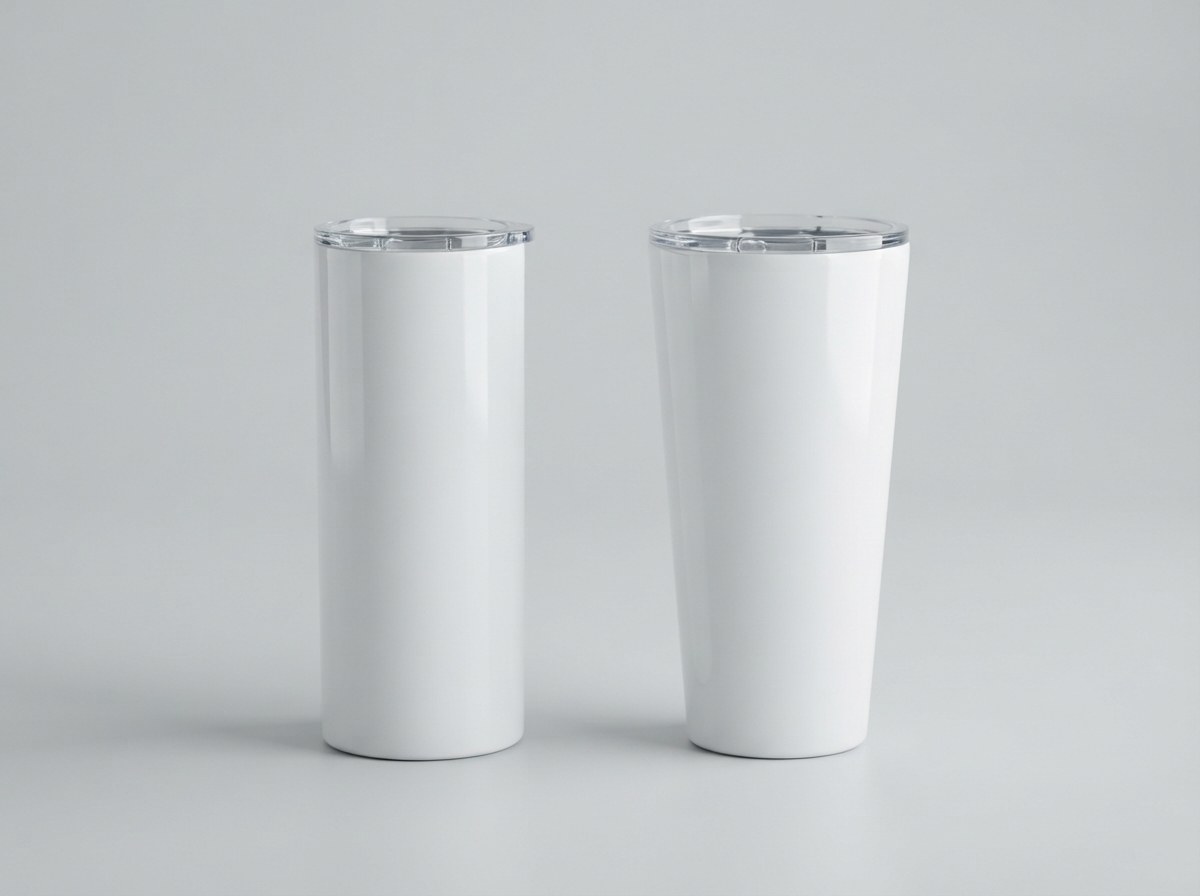
- Straight (cylindrical) tumblers have the same diameter at the rim and at the base — a true cylinder. Unroll the surface flat and you get a perfect rectangle: width equals the circumference, height equals the tumbler's height.
- Tapered tumblers narrow toward the base, like a cone with the tip cut off. Unroll that surface flat and it's not a rectangle — it's a curved panel, wider at the top edge than the bottom edge, because the top circumference is genuinely larger than the bottom circumference.
Why the wrong shape actually fails
A straight rectangular design wrapped around a tapered tumbler doesn't just look "slightly off" — it physically doesn't fit the surface. The rectangle is too wide at the bottom relative to the tumbler's actual bottom circumference, so the excess material wrinkles, folds, or leaves a visible gap and misaligned seam once it's pressed. This is one of the most common reasons a first sublimation tumbler batch comes out looking amateurish, and it's a template problem, not a pressing-technique problem.
Straight vs tapered, side by side
| Straight tumbler | Tapered tumbler | |
|---|---|---|
| Shape when unrolled | Plain rectangle | Curved arc panel |
| Top vs bottom circumference | Equal | Top larger than bottom |
| Design difficulty | Straightforward — any rectangular design fits | Needs a shape-matched template or a warp step |
| Common sizes | 12oz, 20oz skinny, 30oz, 40oz | 20oz skinny tapered, 30oz tapered |
| Typical use | Most beginner-friendly blanks, widest supplier availability | Popular for a more modern silhouette; requires more careful production |
The real numbers: 20oz and 30oz
| Blank | Approximate wrap dimensions |
|---|---|
| 20oz skinny straight | ~9.1 in circumference × 8.25 in height (rectangle) |
| 20oz skinny tapered | ~9.3 in top / ~8.5 in bottom circumference × 8.2 in height (curved) |
| 30oz (either shape, varies by brand) | ~10–10.4 in wide × 9.4–9.7 in high |
Tumbler blanks aren't fully standardized across manufacturers — a "20oz skinny tapered" from one supplier can differ by a few millimeters from another brand's version. These numbers are a solid starting reference, but if a wrap is consistently a hair off on a specific blank, measure that exact tumbler rather than assuming every 20oz tapered is identical.
Mistakes beyond the wrong shape
- Ignoring the seam. Every wrap has a seam where the two edges meet — designs that need to read as continuous (a wraparound pattern, text that shouldn't be interrupted) need the seam placed deliberately, usually at the back, not wherever the file happens to end.
- Skipping the handle area on handled mugs/tumblers. A design that ignores where a handle sits can end up with key artwork hidden behind it once assembled.
- Designing at screen resolution. A design that looks sharp at 72 DPI on a monitor is frequently well under 300 DPI once scaled to actual wrap size — always design or export at the template's real print resolution, not a resized web image.
- Assuming every supplier's blank matches a generic size chart. As covered above, tapered blanks especially vary by manufacturer — a template built for a different brand's 20oz tapered tumbler may be close but not exact.
If you're deciding which shape to stock first: straight tumblers are the easier starting point — one template size fits every blank of that size from any supplier, and there's no risk of brand-to-brand measurement drift. Add tapered once you're ready to measure a specific blank and want the more modern silhouette it offers — the setup cost is higher, but it isn't a harder product to sell once the template is right.
Building a print-ready template for each shape
Identify the shape, not just the volume
"20oz" alone isn't enough information — check whether the blank is straight or tapered before choosing a template, since the two need genuinely different artwork geometry.
Measure the actual blank, especially if tapered
A soft measuring tape around the top rim and around the base, plus the height from base to rim, takes under a minute and removes the guesswork entirely. For a straight tumbler the top and bottom numbers should match (confirming it really is straight); for a tapered one, the difference between them is exactly what a generic size chart can't tell you about your specific supplier's blank.
Straight tumblers: use a fixed-size template
Because every straight tumbler of a given size shares the same rectangle dimensions, a standard template works reliably. The Mug & Tumbler Sublimation Template Generator produces 300 DPI PNG and SVG templates for 11oz/15oz mugs and 12/20/30/40oz straight tumblers, with bleed, safe area, handle position and seam already marked.
Tapered tumblers: match the exact curve
Because tapered blanks vary by brand, a one-size template is a guess. The Tapered Tumbler Template & Design Warp tool takes the actual top circumference, bottom circumference and height of your specific blank and outputs the correct curved template — a 300 DPI PNG, a true-size SVG and a print-at-100% PDF — and can warp an existing straight design into that curved shape directly, with seam and mirroring handled.
Print at 100% scale, check before a full batch
Print one test wrap at true size before committing to a full run — a template that's even slightly miscalibrated compounds across an entire batch of pressed tumblers.
If you sell the same design on both straight and tapered tumblers, design the artwork on the straight (rectangular) template first — it's the simpler shape to work in — then warp it into the tapered version rather than designing the curved version from scratch twice.
Get the right template for your exact tumbler
Straight tumbler? Generate a ready-made 300 DPI template. Tapered? Enter your blank's real measurements and get a template that actually fits the curve.
Straight tumbler templates →