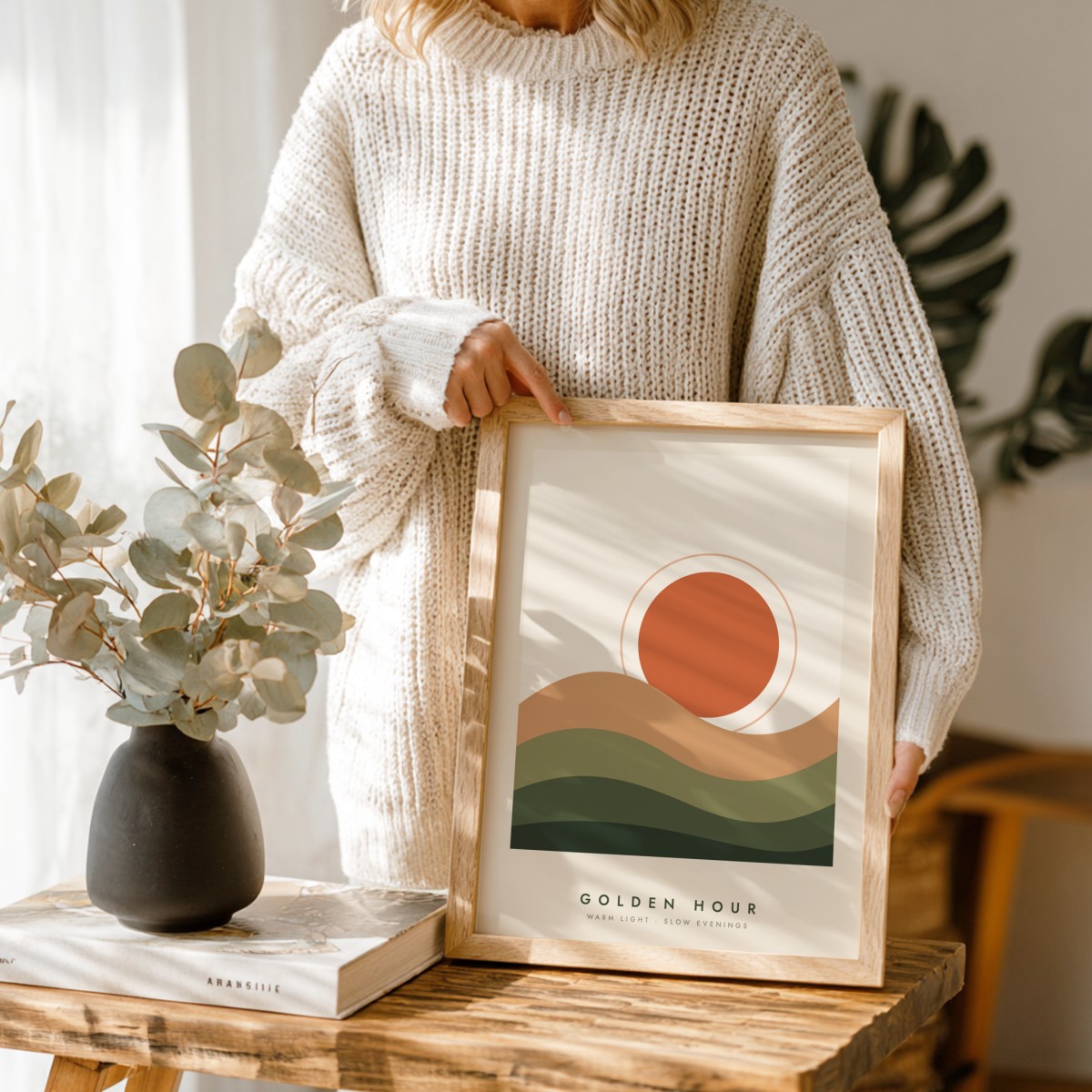
The difference between a 500-sale Etsy shop and a 50,000-sale one usually isn't the designs. It's the photos. Top sellers use mockups to show products in real spaces, maintain visual consistency across their shop, and move fast enough to list new designs before they second-guess them. Batch generation is what makes that speed possible.
Browse the top 1% of Etsy shops in any niche and you'll notice something. The designs aren't always exceptional. What they have is photos that stop scrolling — product shots in real rooms, on real people, in contexts that make a buyer think "that would look good in my house."
The shops that struggle often have the opposite problem: technically good designs shown on a plain background, or on the same generic mockup as every other seller using the same POD supplier. The product looks fine. The listing looks forgettable.
The Photo Is the Decision Point
On Etsy, nobody reads the description first. They stop — or don't stop — based on the thumbnail. Your main photo has maybe half a second to earn a click from the search results page. After that, the listing lives or dies on whether the photos sell the lifestyle, not just the product.
Top sellers understand this intuitively. They don't just show what the product looks like. They show where it lives: a botanical print above a linen sofa, a mug on a kitchen counter in morning light, a tote bag slung over a shoulder at a farmers market. The buyer isn't imagining the product — they're imagining owning it.
Pull up your target keyword on Etsy and look at the search results page. If your main photo looks similar to the others around it, a buyer has no reason to click yours specifically. The photo's job is to stand out on that page before anything else.
Consistency Turns Browsers Into Return Buyers
The shops that grow fastest aren't just accumulating sales — they're building recognition. When a buyer sees your listing in search results and it looks familiar, that's brand equity doing real work.
Mockups are one of the main tools for this. When every listing in your shop uses the same set of mockup styles — the same frames, the same room aesthetic, the same general palette — the shop starts to look like a curated brand rather than a collection of unrelated products. Buyers who land on your shop page scroll instead of bouncing.
Most sellers end up with the opposite. They use whatever mockup comes to hand for each new listing and the visual language ends up scattered. The shops that have figured this out treat their mockup selection as a branding decision, not just a photo task.
Volume Is Part of the Strategy
Most guides focus on making each listing better. The top sellers also focus on making more of them. A shop with 400 listings across the same niche appears in more searches, captures more keyword variations, and gives Etsy's algorithm more signals to work with. It's not just about quality — coverage matters.
The math on this changes when you can generate mockups in bulk. A seller doing it manually might list 2-3 new products a week. A seller using batch generation can realistically list 20. That's not a small difference compounded over a year.
What Each Photo in the Set Actually Needs to Do
Nine photo slots is more than most sellers use. Top performers fill all of them because each photo handles a different job in the buyer's decision process.
- Photo 1 — lifestyle main shot in context, designed to earn the click from search results
- Photos 2-3 — different room or setting, showing the product works in more than one space
- Photos 4-5 — close-up detail shot showing print quality and finish
- Photos 6-7 — scale reference (frame next to furniture, mug in someone's hands)
- Photos 8-9 — styled flat lay or alternative angle for variety
A buyer who scrolls through all 9 photos is very likely to add to cart. The photos handle the objections so the description doesn't have to.
The close-up detail shot is underrated. POD buyers worry about print quality — they've ordered things before that looked different in person. A sharp close-up of the design at actual print size addresses that concern before they even think to ask.
How Batch Generation Changes What's Possible
The gap between sellers who post 5 listings a month and sellers who post 50 usually isn't design ability. It's the time photos take.
Manual mockup work — opening Photoshop, placing the design, exporting, repeating for each template — can run 20-30 minutes per listing if you're doing it properly with multiple photo variations. Across a 20-product launch, that's close to 10 hours just on photos, before you've written a single title or tag.
Batch mockup generators flip the model. You upload your design once, pick your templates, and generate every combination in one job. The time cost of a 20-listing launch drops from a full day to under an hour. Tools like Scaylr handle this without Photoshop — upload your design, select PSD templates from the free template library, download the full set as a ZIP. That's what lets high-volume sellers move at the speed they do.
It's also worth reading how Etsy SEO works for POD shops alongside the mockup strategy — photos earn the click, but keywords get you in front of the right buyer in the first place.
What the Top Shops Actually Do Differently
Looking at high-volume Etsy shops closely, a few patterns come up consistently.
They don't use the default POD supplier mockup. Printful and Printify mockups are fine, but every other seller using those suppliers has the same photos. Custom mockups are a direct competitive advantage that costs nothing extra if you're already generating them in batch.
They match mockup style to their niche aesthetic. A cottagecore botanical shop uses different frames and room settings than a modern minimalist shop — and that consistency runs through every single listing. It's not accidental.
They update their mockup set periodically. Interior trends shift. A room setting that felt fresh in 2023 can look dated by 2025. Refreshing the photo set on existing listings also gives them a small ranking signal from the activity.
They test different thumbnails. Running the same design with two different main photos on separate listings and tracking which one converts better is low-effort A/B testing with real data. Most sellers never do this. The ones who do find clear patterns they can apply across the rest of their shop.
Most of this isn't complicated — it's consistent. The sellers who build 10,000-sale shops pick a mockup style, stick to it, list often, and keep photo quality high. Batch generation just makes the "list often" part realistic.
Generate your Etsy mockup photos in bulk
Upload your design once, apply it across dozens of professional PSD templates, download as a ZIP. No Photoshop required.
Try Scaylr Free →